Azure Storage: GA Support for Entra ID and RBAC in Supplemental APIs

On 26 August 2025, Microsoft announced the general availability (GA) of Entra ID authentication and role-based access control (RBAC) for several supplemental Azure Storage APIs. This update improves security and gives administrators more precise control over sensitive operations such as managing container, queue, and table access permissions.

What has changed

The following APIs now support Entra ID and RBAC:

  • GetAccountInfo
  • GetContainerACL / SetContainerACL
  • GetQueueACL / SetQueueACL
  • GetTableACL / SetTableACL

These APIs now support OAuth 2.0 authentication via Entra ID.
A key change is the way error responses are returned:

  • Before: using OAuth without the right permissions resulted in 404 (not found).
  • Now:
    • 403 (forbidden) is returned when OAuth is used but the caller does not have the required permission (for example, Microsoft.Storage/storageAccounts/blobServices/getInfo/action for GetAccountInfo).
    • 401 (unauthorised) is returned for anonymous requests.
    • 404 (not found) is still possible if the resource itself does not exist.

If your application logic depends on the old 404 behaviour, you should update it to handle both 404 and 403 responses. Microsoft also recommends not relying on error codes to detect unsupported APIs but instead following the Entra ID authorization guidance.

Why this matters

  • Improved security – no more reliance on shared keys.
  • Granular access – assign only the necessary permissions.
  • Consistent responses – OAuth error codes now match industry standards.
  • Application impact – developers may need to update their code to support the new response model.

Continue reading “Azure Storage: GA Support for Entra ID and RBAC in Supplemental APIs”

Creating Azure Support Tickets with PowerShell: A Step-by-Step Guide

24-7-IT-Support

Introduction

As cloud services become increasingly complex, the ability to manage and troubleshoot them effectively is crucial. Azure, Microsoft’s cloud computing service, offers a range of tools to help with this. Today, we’ll explore how you can leverage PowerShell, to create support tickets in Azure. This is particularly useful for automating support processes or integrating them into your existing PowerShell scripts.

Prerequisites
  • An Azure subscription
  • PowerShell installed on your system
  • Azure PowerShell Module

Step 1: Installing Azure PowerShell Module

First, ensure that the Azure PowerShell module is installed on your system. Open PowerShell and run:

Install-Module -Name Az -AllowClobber -Scope CurrentUser

Step 2: Authenticating with Azure

Next, log in to your Azure account using:

Connect-AzAccount

Follow the prompts to complete the authentication.

Continue reading “Creating Azure Support Tickets with PowerShell: A Step-by-Step Guide”

Automating Device Wipe in Microsoft 365 with PowerShell and Azure

In today’s digitally connected world, organizations often need to manage and secure their devices efficiently. This includes the ability to remotely wipe devices in case they are lost or stolen. Microsoft 365 offers powerful tools for device management and security, and with PowerShell and Azure, you can automate the process of wiping devices when needed.

In this blog post, we will walk you through a PowerShell script that utilizes Azure and Microsoft Graph API to search for a user and remotely wipe their devices if necessary. We will also include some Azure screenshots to help you visualize the process.

Prerequisites

Before we begin, make sure you have the following prerequisites in place:

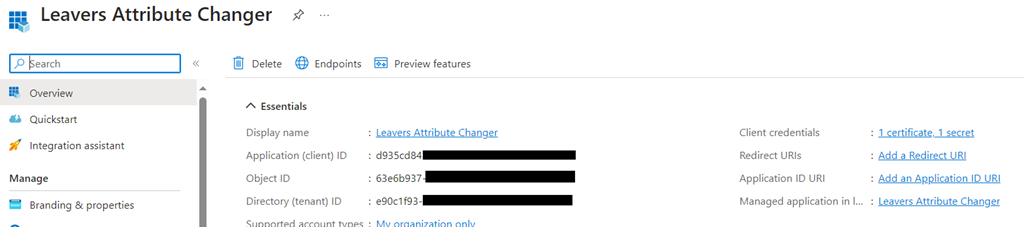
    Azure AD App Registration: You will need to register an Azure AD App and obtain the AppID and AppSecret for authentication.

Wipe_01

    Microsoft 365 Tenant: You should have access to a Microsoft 365 tenant, and you’ll need to know the tenant ID (e.g., $Tenant = “YourTenantName”).

Microsoft Graph API: Make sure you have permissions to use the Microsoft Graph API and can authenticate with the provided App ID and App Secret.

Wipe_02

Continue reading “Automating Device Wipe in Microsoft 365 with PowerShell and Azure”